Vsphere Ha Slot Size Calculation
- Vmware Ha Slot Size Calculation
- Vsphere Ha Slot Size Calculations
- Vsphere Ha Slot Size Calculation Calculator
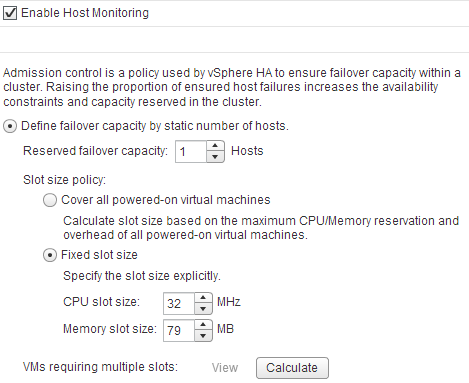
Feb 05, 2013 The slot has two parts, the CPU component and the memory component. Each of them has its own calculation. If there are no virtual machine resource reservations in the cluster, then the slot size (for ESXi 5 at least) is 32 Mhz for CPU and 0 MBs + overhead for memory. (I’ve used 80 MBs as my memory overhead in the examples). Available slots = Total slot – Used slots i,e Available slots = 234 – 6 = 228. It should come as 228 as available slots but why Available slots is 150 in the above snapshot. Is that wrong or VMware did something wrong in HA slot calculation? Below is the method of calculation for Total Slots, Used Slots & Available slots. HA uses the highest CPU reservation of any given VM and the highest memory reservation of any given VM. If VM1 has 2GHZ and 1024GB reserved and VM2 has 1GHZ and 2048GB reserved the slot size for memory will be 2048MB+memory overhead and the slot size for CPU will be 2GHZ. Now how does HA calculate how many slots are available per host? The slot has two parts, the CPU component and the memory component. Each of them has its own calculation. If there are no virtual machine resource reservations in the cluster, then the slot size (for ESXi 5 at least) is 32 Mhz for CPU and 0 MBs + overhead for memory. (I’ve used 80 MBs as my memory overhead in the examples).
Vmware Ha Slot Size Calculation
Vsphere Ha Slot Size Calculations
We recently moved our ISO store from a legacy NFS server to our main NFS filer.
The first task was copying the actual files, which can be done via any machine that has both datastores mounted (with read-write access to the destination store).
Vsphere Ha Slot Size Calculation Calculator
The more significant job is reconfiguring the VMs to use the copies of the ISOs in the new datastore.

Here’s the PowerCLI script I used:
It’s fairly self-explanatory.

The biggest caveat with this is that it assumes that the source and destination stores have the same structure, but it wouldn’t be difficult to amend it to change the destination path slightly.