Top Ten Poker Hands Preflop
The highest valued poker hand and one that you are going to want to be dealt out to you when your fellow players all have high valued hands is the Royal Flush hand. The hand is simply made up of a set of five cards which are the Ace, King, Queen, Jack and Ten cards, and to be a Royal Flush they must all be in the same suit. Get this hand when. Normally referred to as a caller, the poker term for these players in the pre-flop betting round is 'Limper'. In the chart named 'Calling from the small blind without any pre-flop raises', you learn with which hands you should call from the small blind with no previous raiser. So make sure you think very carefully before every flop and build the foundations for a profitable hand by making the correct preflop strategy decision. Preflop starting hand selection. Choosing which hands to play and which hands to fold is fundamental to playing a winning poker game. The best hands to play in Texas Holdem are: Big pocket. You are currently in Dealer Mode. To return to the e-commerce site, click here again.
Poker Strategy
Poker Reviews
Poker Bonuses
Shoring up your preflop game is one of the quickest and surest ways to improve your overall game and make more money at the poker table. One of the most common weaknesses shared by newer poker players is a tendency to call too often preflop. Playing fewer hands and playing them aggressively is an excellent way for any new player to improve his game in a hurry.
Whether you are new to the game or an experienced veteran, this guide will give you plenty of tips to help you play better poker. This guide is geared towards no limit holdem players, non-holdem players can find information on their preferred game in the strategy section on the left.
Top 5 preflop tips
1. Aggressive in Position, Tight out of Position
You should play many more hands when you are in late position than when you are in early position. Players who are last to act post flop have more information about their opponent’s hand before they have to make a decision. They know whether their opponent has bet or checked. The player in late position’s hand doesn’t need to be quite as strong since they can base their decision on the presumed strength of their opponent’s hand. The additional information makes up for the slightly weaker average starting hand.
The following guide is a good place to start for new players looking for a pre-flop NL holdem starting hand chart. Keep in mind that pre-flop NL holdem hand evaluation changes dramatically between cash games and SNGs and depending on relative stack sizes or a player’s preferred style.
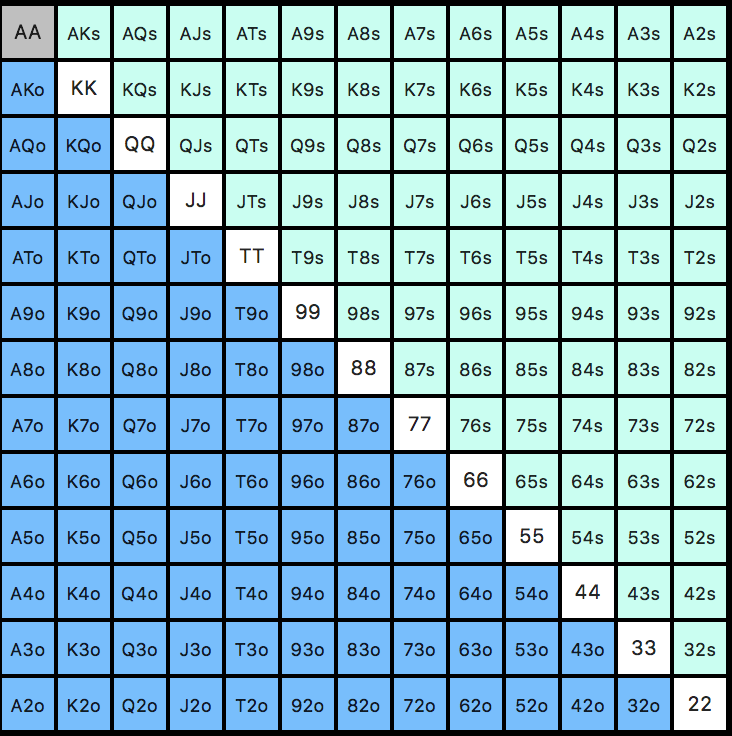
In a 6-max cash game, you can open raise under the gun with any big pairs, medium pairs, AK, AQ, and the stronger of the two big card hands. In middle position add the rest of the pairs and big cards. In late position you can begin to add suited connectors and some marginal hands.
In an SNG or multi-table tournament you can use the cash game guidelines as a baseline. However these guidelines must be adjusted radically based on your stack size relative to that of your table mates and whether or not the tournament is approaching the bubble. Check out our top 5 SNG tips and top 5 tournament poker tips for more information on how to adjust your play for SNGs and tournaments.
2. Raise When Entering the Pot
Whenever you are opening a pot, or entering a pot with limpers in the pot, you should come in for a raise. Raising helps to better define your opponent’s hand(s) and makes playing your hand post flop much easier. For instance, your opponents may limp in with any number of speculative hands, but it is much less likely for them to call a raise out of position with these types of hands. Limiting your opponent’s range of hands by raising pre-flop allows you to have a better idea of what they might be holding post flop, thus making your decisions easier.
Additionally, raising preflop gives you the initiative in the hand and forces your opponent’s to play reactive poker. It is much more difficult for your opponent’s to play against you if they begin the hand on the back foot. It is easier for you to play your hand if you start the hand by raising.
3. Look for Implied Odds Situations
Implied odds situations arise whenever you can safely assume that your opponent’s hand is very strong. For instance, if your opponent is a tight player and he raises to $4 from under the gun in a $100 NL holdem game, and you have a pair of threes in middle position, you are approximately 30% to win vs. a hand range of AA, KK, QQ, and AK. On the face of it, this is an easy fold with a pair of threes as a 30% win rate doesn’t justify calling $4 to win a pot of $11. However, you can assume that if you hit three of a kind on the flop that you will win a very large pot because your opponent has given you reason to think he has a very strong hand. The additional money that you expect to win on later streets in a poker hand is known as implied odds.
If you suspect your opponent has a very strong hand, you should try to see a flop as cheaply as possible with hands that have strong implied odds. These are hands that are easy to play post flop and have the potential to make a strong hand. Hands with good implied odds include all pairs and the majority of suited connectors.
Check out our Top 5 Poker Sites and choose your favorite online casino now!
4. Pay Attention to Your Opponents
Paying attention to the ranges and tendencies of your opponents will give you a huge advantage in helping you determine how to make decisions at the poker table. Players with a very loose raising range can be abused with isolation reraises and continuation bets. Advanced players may even try floating very aggressive players. Very tight players can be abused by looking for implied odds situations. You can also look for scary flops to try to raise tight players off of one-pair hands.
Look for deviations from a player’s typical play style.
If you notice a player is prone to calling a lot and limping in preflop, and then suddenly that player raises preflop, there is a strong likelihood that the player has a very premium hand. If you have a hand that plays well post flop, try to flop a huge hand and win a big pot.
Conversely if you know that a particular player is prone to lead weak hands or bluff a lot post-flop, and suddenly he check-raises, you should be wary of the strength of his hand.

5. Be Willing to Fold
It can be difficult to let go of pocket queens preflop when it’s the best hand you’ve seen in hours. However, if the situation merits a fold, you must have the discipline to fold the hand if you want to be a winning poker player. This piece of advice is even more important in low stakes NL holdem games. Most low-stakes grinders aren’t creative enough to try to force a player to fold an obviously strong hand by bluffing an even greater show of strength. Unless you have a good reason not to, believe the 4-bet raise, it is probably the nuts.

Download Pokerstars and Get Your Piece of the Action!
Pokerstars is far and away the largest and most reliable online poker site in the world! If you are looking for tons of action at all hours, you got it. Need reliable cashouts? No problem. Want $600 dollars just for signing up through TopFivePoker.com? Just click here!Top 5 Poker Rooms
Top Ten Worst Starting Holdem Poker Hands
Everyone knows that pocket aces are the best starting hand in a game of no limit texas holdem poker, but are you familiar with what the worst hands are?
Join me as we go on a trip to the land of Texas Fold’em.
1) 7-2
Top 10 Poker Hands Pre Flop
72 is the #1 worst hand of them all. This is based on the fact that you can not make a straight with both cards and if you hit a flush you will have a very low flush at that. Even if you pair one of these two hole cards you are at worst hitting bottom pair with below average kicker, or at best top pair with bottom kicker.
Top Ten Poker Hands Preflop
2) 8-2
This hand suffers from the same inadequacies at 72u, however you have an 8 instead of a 7. Which makes things slightly better. But not by much. The only time you will be in front pre-flop is if you are playing against someone having a pop with 72u.
3) 8-3 & 7-3
You are unable to make a straight with 8-3. With 7-3 you are looking for a miracle flop to be in with any chance of winning the pot.
4) 2-6
Even if you make your straight you will not be able to guarantee you have the best hand. Players with suited connectors like 67 will make sure you lose a lot of chips. If you find yourself playing this hand against 4 other players you will only ever win around 10% of the time.
5) 2-9, 3-9, & 4-9
The only positive quality about these hands is the 9. If you pair your 9 on the flop (unlikely), you will have a middling pair but with an awful kicker. The best way to lose a lot of chips is to play a second-best hand, and that is exactly what will happen if you play any of these card combinations.

6) T-2
The legendary Doyle Brunsen hand made famous by him winning two WSOP bracelets with this hand. But do not be fooled. T2 is NOT a good hand. Do not play this hand unless you have the skill and experience of the legend that is the Brunsen. Or unless you like to lose money.
7) 9-5
95 is also known as the “Dolly Parton”. Maybe because of the song, but mostly because it’s ugly trash. Don’t play hands that have special names, or are your “favourite” hands. You should be selecting your starting hands based on strong cards and your table position. Hand selection based on the name of your hole cards is very, very stupid.
8.) 4-7, 4-8, 5-8, 3-6…
Any two low unpaired unsuited cards will rarely win unless you catch that dream flop. But odds are never ever in your favour to see a flop in the hope that you might hit it. For every one time you do hit a full house on the flop with these kinds of cards, there will be 100 times where you miss. Fold these hands. Even if on the small blind, even if you are getting value. If you do connect with the flop in some way, chances are it will be a trouble hand and before you know it you won’t be able to get away and you will find yourself pot comitted.
9) Face card (K, Q, J) + low card, unsuited
This is one of the more common mistakes made by beginners to the game. Picture cards by themselves are not worth anything. Put them with another card of the same rank and you’ve got a playable hand. But hands like J4, Q2, K3 are all Texas Fold’em hands. Even if you do pair your paint, chances are you will be outkicked at the showdown.
10) Ace + low card, unsuited
Another common beginner mistake to avoid is playing a raggy ace. That is an ace with a low kicker. Ok, so its not too bad heads up, and if you flop two pair against someone with AK then you are laughing, but this will not happen often enough to make it profitable to play. If someone is raising pre-flop in front of you, then your best strategy is to fold. Even if you do hit your ace on the flop, chances are someone else has too and more often than not they are playing with a much stronger kicker.