O'ring Slot Design
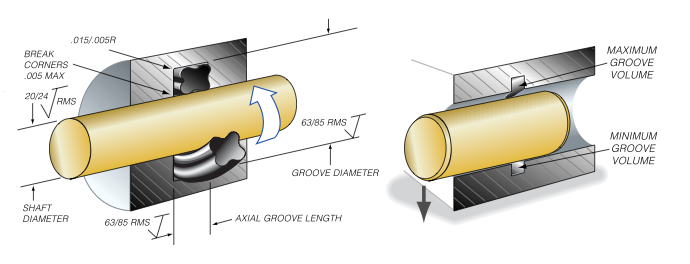
- Oring Slot Design
- O Ring Groove Design Formula
- O-ring Groove Design For Vacuum
- O-ring Groove Design Trelleborg
II Parker Hanni n Corporation O-Ring Division 2360 Palumbo Drive, Lexington, K 40509 Phone: (859) 269-2351. Fax: (859) 335-5128 www.parkerorings.com Parker O-Ring Handbook. Parker´s O-Ring Selector is an engineering tool which offers O-ring material and size selection combined in one tool. Both are interlinked, thus ensuring the best possible combination of the calculated O-ring size and material choice.
In this article we will see the basic difference between slot , holes, groove, and keyways.
1. Hole: circular cutout, either through the material or to a blind depth.
Types of Hole :
Oring Slot Design
They are different types of holes that are mentioned below.
1.Simple Hole
2.Counter board
3.counter sunk
4.Tapered
5.counter drilled.
2. Slot or Slotted Holes: an elongated hole. It is stretched in one direction but still has full radii on the ends. A slot is cut into a flat plate or normal to the axis of a cylinder.
Slot Hole Design Consideration :
Slotted holes are widely used in most sorts of mechanical design. Apply mainly in precisely fine-tuning for uncontrollable dimensions beforehand, alignment accuracy, fixation in certain direction meanwhile keeping slipping free in other directions, and so on. Such as tension device of belt pulley, thermal stress protection for slender bar structural parts or long spindle shafts, alignment accuracy in complex dimension chain, a mechanism for enhancing tolerance, and eliminating accumulated error.
In mechanical design, some principles and factors we should take into account include the shape and travel of the slotted holes, the structural strength affected by the holes, and so on. In actual application, they can be classified into the following types: singleton slotted holes, coupled slotted holes.
Slotted Holes Slotted holes can be dimensioned in several different ways.
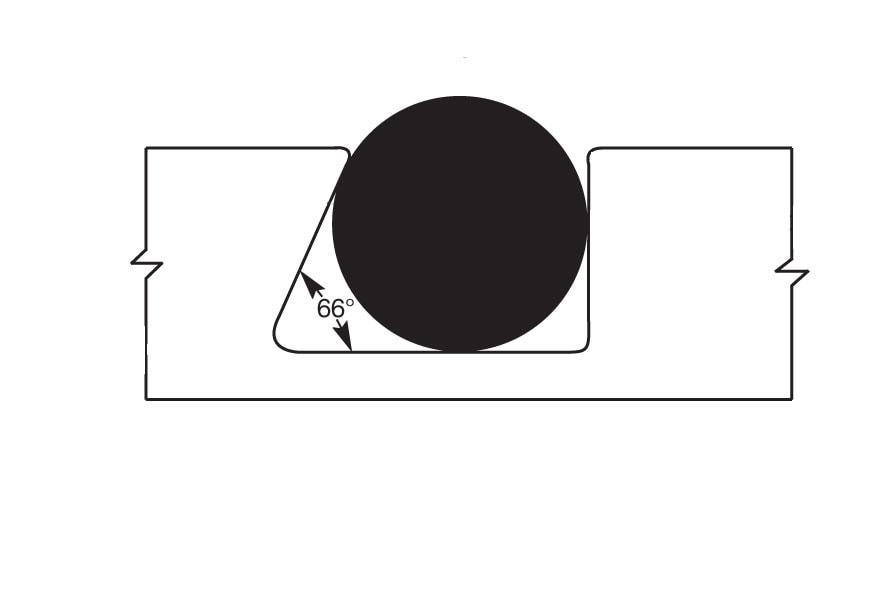
a. Center points on the longitudinal axis are located and the radii are indicated with a note.
b. Linear measurements indicate the overall size of the slot and the radii are specified.
c. A note indicates the two linear dimensions of the slot and another note specifies the radii.
Choose the most appropriate technique for sizing the slotted hole. The technique used for sizing the slot determines how the slot is located.
See Also: What is Slotting Machine- Principal parts of Slotter Machine
3. Groove:a groove is a cylindrical slot. Grooves are cut around the OD or ID of a cylinder and do not pass through the axis of the cylinder.
You can simply understand that a slot can be through or blind but a groove is always blind.
In manufacturing or mechanical engineering a groove is a long and narrow indentation built into a material, generally for the purpose of allowing another material or part to move within the groove and be guided by it.
Examples include:
- A canal cut in a hard material, usually metal. This canal can be round, oval or an arc in order to receive another component such as a boss, a tongue or a gasket. It can also be on the circumference of a dowel, a bolt, an axle or on the outside or inside of a tube or pipe etc. This canal may receive a circlip an o-ring or a gasket.
- A depression on the entire circumference of a cast or machined wheel, a pulley or sheave. This depression may receive a cable, a rope or a belt.
- A longitudinal channel formed in a hot rolled rail profile such as a grooved rail. This groove is for the flange on a train wheel.
4. Keyway:
In mechanical engineering, a key is a machine element used to connect a rotating machine element to a shaft. The key prevents relative rotation between the two parts and may enable torque transmission. For a key to function, the shaft and rotating machine element must have a keyway and a keyseat, which is a slot and pocket in which the key fits. The whole system is called a keyed joint.
O Ring Groove Design Formula
Read More: Types Of Mechanical Keys- Design Of Keys.
Related posts:
O-ring Groove Design For Vacuum
Of the four characteristics that define an o-ring (material, durometer, color, and size), determining and properly communicating the exact size needed is often the trickiest part of an order. Applying tried and true methods for determining the correct size will save you time in the short-term and frustration and additional cost down the road. Read on to learn how to properly size an o-ring the first time around.
How to Measure O-Ring CS and ID
The best way to size an o-ring is by measuring the CS (cross-section) and ID (inside diameter). For measuring the cross-section, it is best to use a caliper, a.k.a. micrometer. If you don’t have one available, various other sizing tools can be used to get a close estimate.
When measuring very small IDs, it is also best to use a caliper. For larger IDs (over 6 inches), it is best to use an O-Sizer or Pi-Tape.
Once the CS and ID of the o-ring are determined, you can use our AS568 O-Ring Size Chart to determine if these dimensions correspond to one of the “standard” sizes.
Shop For O-RingsMetric vs Standard O-Ring Sizes and Tolerances
All o-rings can be described by either metric (mm) or standard (inch) dimensions. However, if the o-ring matches an AS568 size, that’s the best way to reference it since this is the most common standard here in the USA. If not, you may be able to find a “metric” o-ring that matches the dimensions you need.
One important thing to consider when sizing o-rings is tolerances. Due to manufacturing limitations, there will always be some variance in the dimensions of o-rings. These variances are called tolerances, and the standard acceptable tolerances are specified in the previously mentioned AS568 O-Ring Size Chart or the Metric Tolerances Chart for Metric O-rings. As an example, for any of the AS568 100 Series o-rings, the cross-section is .103” with a tolerance of ± .003”. This means the cross-section could measure as small as .100” or as large as .106”.
O-Ring Standard (AS568) Sizes
If the CS is one of the standard AS568 sizes such as .070, .103, .139, .210, or .275 inches, then you probably have a standard-sized o-ring. Measure its ID, and look it up on a size chart. If the ID is listed on the chart (or within tolerance), you have a standard size. Look up the 3-digit “dash” # and that will be your o-ring size.
O-ring Groove Design Trelleborg
Metric O-Ring Sizes
If the CS of the o-ring is not one of the standard AS568 sizes, then you may have a “metric” o-ring. In this case, simply measure the CS and the ID as discussed above to identify the size needed on our metric size chart. At Global O-Ring, we identify metric sizes by their CS X ID in the format #.##X###. So for example, a 1 mm CS X 5 mm ID o-ring would be 1.00X005.
Various Tools to Size an O-Ring & Best Applications
It may be tempting to use a ruler or tape measure, but these will not give you the detailed measurements you need. Instead, we recommend the following tools (all available in the Global O-Ring and Seal store) to size o-rings:
- Laminated Size Chart for AS568 Sizes – Stop here to get our easy to use flip chart featuring the silhouettes of 239 different sizes of o-rings.
- Molded Sizing Cone – Place your o-ring on this cone to see if it is the same size as one of our 184 most popular sizes.
- Sizing Gauge – This sliding gauge can measure the inside diameter of an o-ring up to 13 inches.
- Calipers – A preferred tool for precise measurement, this sliding tool can measure the diameter and length of many components, including o-rings. Most calipers will only extend 6 inches, and a different tool is needed for those larger than 6” IDs.
- O-Sizer – This specially designed o-ring measuring tape comes in three different sizes and is used to measure the ID of metric and AS568 o-rings up to 26”.
- Pi-Tape – The most precise tool to measure the inside diameter of an o-ring. Pi-Tapes are metal precision-engineered tapes designed for the specific purpose of measuring the ID of a round object. Each Pi Tape will measure to the thousandths of an inch (.001”). There are various size options depending on the ID you need to measure, but the most common sizes are 2-12”, 12-24”, 24-36”, 36-48”, and 48-60”.
Global O-Ring and Seal’s Sizes Selection for O-Rings
Global O-Ring and Seal carries a full line of o-rings in all standard AS568 and most metric sizes. We are also here to guide you through the sizing process. Give us a call at 832-448-5550 to speak with an Industry Expert, or if you are local to the Houston area, come visit us at our Will Call department for more help on sizing o-rings.
Shop For O-Rings